
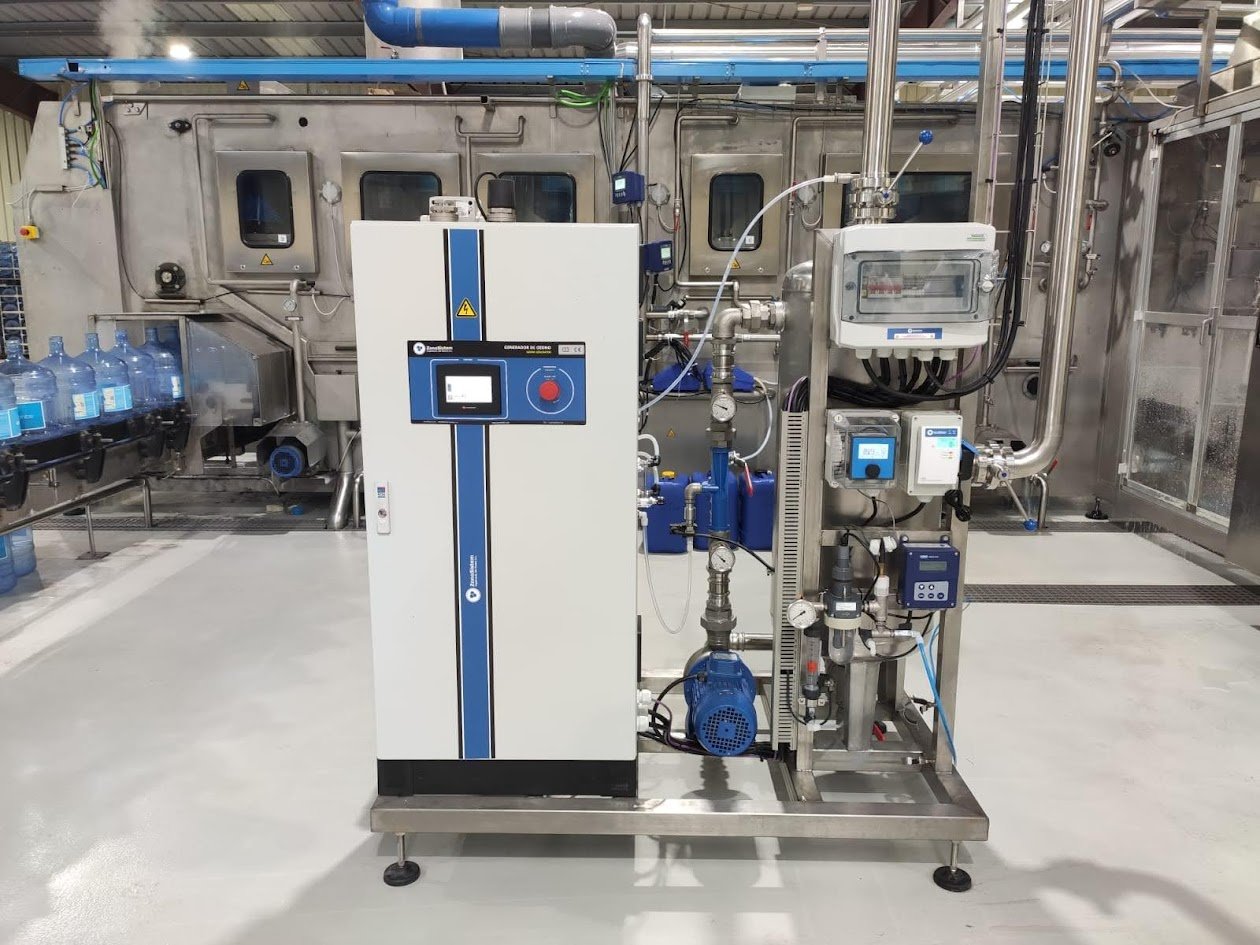
Ozone generator sizing is not just a grams-per-hour calculation. Correct selection depends on water flow rate, target ozone dose, ozone demand, contact time, transfer efficiency, feed gas quality and how the residual ozone or off-gas will be controlled.
Quick Answer: How Do You Size an Ozone Generator?
To size an ozone generator for water treatment, start with the water flow rate and target ozone dose, then allow for ozone demand, transfer efficiency, contact time and operating variability.
Basic theoretical estimate:
Ozone required (g/h) = Water flow rate (m³/h) × Target ozone dose (mg/L)
This calculation gives a useful starting point, but it is not the final generator selection. In real systems, not all generated ozone dissolves into the water, and not all dissolved ozone remains available for the target treatment. Some ozone is consumed by the water, some may leave as off-gas, and some may decay before the required contact time is achieved.
Why Ozone Generator Sizing Is Often Misunderstood
A common mistake is to select an ozone generator based only on the headline output, usually stated in grams per hour. This figure tells you how much ozone the generator can produce under certain conditions, but it does not tell you how much ozone will actually dissolve into the water or how effectively it will treat the process.
For example, a 20 g/h ozone generator does not automatically deliver 20 grams of useful dissolved ozone into the water every hour. The actual treatment effect depends on the full system design, including the injector, pressure, mixing, contact tank, water quality and control method.
This is why ozone should be treated as an engineered process, not simply as a machine selection exercise.
If you are new to ozone treatment, it may also be useful to read our guide on what ozonation means and our explanation of how ozone generators work.
Basic Ozone Generator Sizing Formula
For water treatment, the simplest theoretical sizing estimate is based on flow rate and target ozone dose:
Ozone required (g/h) = Water flow rate (m³/h) × Target ozone dose (mg/L)
This works because 1 mg/L is approximately equal to 1 gram of ozone per cubic metre of water.
For example, if a system treats 10 m³/h and the target applied ozone dose is 2 mg/L:
- Water flow rate: 10 m³/h
- Target ozone dose: 2 mg/L
- Theoretical ozone requirement: 10 × 2 = 20 g/h
In theory, this suggests a 20 g/h ozone requirement. In practice, the selected generator may need to be larger because the calculation does not yet include transfer efficiency, ozone demand, residual requirements or process losses.
Example Ozone Generator Sizing Calculation
Consider a water treatment process with the following starting conditions:
- Water flow rate: 10 m³/h
- Target applied ozone dose: 2 mg/L
- Theoretical ozone requirement: 20 g/h
- Estimated transfer efficiency: 70%
If only 70% of the generated ozone is expected to transfer into the water, the generator output must be adjusted:
Adjusted generator output = 20 g/h ÷ 0.70 = approximately 28.6 g/h
This means that a generator of around 30 g/h may be considered as a starting point, depending on the wider process conditions.
However, this is still only an estimate. If the water has high ozone demand, if a dissolved ozone residual must be maintained, or if the system has limited contact time, additional capacity or a different system design may be required.
Applied Ozone Dose vs Dissolved Ozone Residual
Applied ozone dose and dissolved ozone residual are not the same thing.
The applied ozone dose is the amount of ozone introduced into the process. The dissolved ozone residual is the measurable ozone remaining in the water after ozone demand and process losses have been satisfied.
A system may apply ozone at a calculated dose but still show little or no dissolved residual if the water has high ozone demand. This is common in waters containing organic matter, suspended solids, dissolved metals, colour, odour compounds or other oxidisable substances.
For disinfection or process control applications where a measurable residual is required, sizing must allow for both the initial ozone consumption and the target residual level.
For more background on dissolved ozone in water, see our guide: What Is Ozonated Water and How Is It Produced?
Ozone Demand: The Hidden Factor in Generator Sizing
Ozone demand is the amount of ozone consumed by the water before a useful residual or treatment effect can be achieved. It is one of the most important factors in ozone system sizing.
Two water streams with the same flow rate may require very different ozone generator sizes if their water quality is different. Clean water with low ozone demand may achieve a residual quickly. Water with high organic load, colour, odour, iron, manganese, biofilm or other reactive substances may consume ozone rapidly.
This is why a sizing calculation based only on flow rate and dose can be misleading. In many industrial applications, ozone demand should be assessed through water analysis, bench testing or pilot trials before final equipment selection.
Transfer Efficiency and Why It Matters
Transfer efficiency describes how much of the generated ozone actually dissolves into the water. It has a major impact on generator sizing.
If only 50% to 70% of the generated ozone transfers into the water, the generator output must be higher than the theoretical dissolved ozone requirement. Poor injection design can therefore make an otherwise correctly sized generator appear undersized.
Transfer efficiency is affected by:
- Injector or diffuser design
- Water pressure
- Gas-to-liquid ratio
- Bubble size
- Mixing quality
- Contact tank design
- Water temperature
- Ozone concentration in the gas stream
In many water treatment systems, a well-designed injection and contact system is just as important as the ozone generator itself.
Contact Time and Treatment Objective
Ozone needs contact time to react. The required contact time depends on the treatment objective and the quality of the water.
For example, a system designed for odour reduction may have different contact requirements from a system designed for microbial control. A process aiming to maintain a dissolved ozone residual may need more careful control than a system designed for oxidation only.
Contact time can be provided through:
- Contact tanks
- Pipe loops
- Static mixers
- Recirculation systems
- Pressurised contact vessels
- Defined process retention time
If contact time is too short, increasing generator size alone may not solve the problem. The process may need better mixing, a larger contact volume or a different hydraulic arrangement.
Feed Gas Quality: Air, Dry Air or Oxygen?
Feed gas quality has a direct effect on ozone generator performance. Ozone can be produced from dry air or oxygen, but the output concentration and system efficiency can be very different.
Oxygen-fed ozone generators normally produce a higher ozone concentration than air-fed units. This can be particularly useful in water treatment because higher ozone concentration can improve gas transfer and reduce the volume of gas that needs to be injected into the water.
Moisture in the feed gas should be avoided because it can reduce ozone output, increase maintenance requirements and create unwanted by-products inside the generator. For this reason, industrial ozone systems normally require dry air, oxygen concentrators or dedicated oxygen supply.
In practical terms, a smaller oxygen-fed system can sometimes outperform a larger poorly configured air-fed system, especially where dissolved ozone concentration and transfer efficiency matter.
Water Temperature, pH and Organic Load
Water conditions can significantly affect ozone performance.
Ozone is generally less stable in warmer water. Higher temperatures can reduce ozone solubility and shorten the life of the dissolved ozone residual. This may require a higher applied dose, better contact design or tighter process control.
pH also affects ozone chemistry. In some conditions, ozone reacts directly. In others, it may form hydroxyl radicals, which can change the oxidation pathway. This can be useful in some advanced oxidation applications, but it also means the water chemistry must be understood.
Organic load is another major factor. Water with high levels of organic matter, suspended solids, biofilm or reactive compounds can consume ozone quickly. In these cases, pre-filtration, process cleaning or staged treatment may be needed before ozone can perform effectively.
Off-Gas and Ozone Destruct Requirements
Not all ozone injected into water will dissolve. Some may leave the process as off-gas. This is especially important in enclosed contact tanks, sealed treatment vessels or high-dose ozone systems.
Any ozone that is not transferred into the water must be safely managed. Depending on the system design, this may require an ozone destruct unit, ambient ozone monitoring, ventilation or process interlocks.
Off-gas is not only a safety issue. It is also a sign of transfer efficiency. Excessive off-gas can indicate that the system is producing more ozone than it can dissolve, or that the injection and contact system is not properly designed.
You can also read our technical guide on how ozone destruct units work.
Common Ozone Generator Sizing Mistakes
1. Selecting by flow rate only
Flow rate is important, but it does not tell the full story. Ozone demand, target dose, contact time, transfer efficiency and water quality must also be considered.
2. Assuming generator output equals dissolved ozone
Generator output is not the same as dissolved ozone concentration. Some ozone may be lost as off-gas, consumed by the water or decomposed before it reaches the target point.
3. Ignoring contact time
If ozone does not have enough time to react, simply increasing generator size may not achieve the desired result.
4. Underestimating ozone demand
High organic load, colour, odour compounds, iron, manganese or biofilm can consume ozone rapidly. This can prevent a residual from forming even when ozone is being generated.
5. Oversizing without control
A larger ozone generator is not always better. Oversizing can increase cost, create unstable control, generate unnecessary off-gas and introduce safety concerns.
6. Forgetting off-gas management
Ozone systems should be designed with safe off-gas control from the beginning, particularly where contact tanks, sealed vessels or high concentrations are involved.
When Should You Test or Pilot an Ozone System?
Testing is strongly recommended where the water quality is variable, the ozone demand is unknown or the treatment target is difficult to predict from theory alone.
Bench testing or pilot trials can help assess:
- Actual ozone demand
- Required dose range
- Contact time requirement
- Residual ozone behaviour
- Colour or odour reduction
- Potential by-products or process impacts
- Suitability of ozone as part of the overall treatment strategy
For applications such as wastewater polishing, surfactant reduction, colour removal, difficult odour control or complex process water, testing can prevent costly oversizing or inappropriate equipment selection.
Practical Information Needed for Ozone Generator Sizing
Before selecting an ozone generator, it is useful to gather the following information:
- Water flow rate, minimum, average and maximum
- Operating hours per day
- Target treatment objective
- Target ozone dose or dissolved ozone residual, if known
- Available contact time
- Water temperature
- pH
- COD, BOD, TOC or other organic load indicators, where relevant
- Suspended solids or turbidity
- Iron, manganese or other reactive compounds
- Available pressure and hydraulic arrangement
- Whether a contact tank or recirculation loop is available
- Safety requirements and installation environment
- Whether off-gas destruction will be required
The more accurately these details are known, the more reliable the ozone system selection will be.
Ozone Generator Sizing Is a System Design Question
The correct ozone generator size depends on the complete system, not only the generator rating. A good design considers ozone production, feed gas quality, injection method, contact time, monitoring, control and off-gas management together.
In many cases, the best solution is not simply the largest available generator. It is the correctly matched system for the application.
Ozcon supports industrial and commercial ozone projects where system selection, process understanding and practical implementation are critical. This includes ozone water treatment, commercial ozone generators, off-gas control and complete ozone process design.
Related Ozone Sizing and Water Treatment Guides
Speak to Ozcon About Ozone Generator Sizing
If you are trying to size an ozone generator for water treatment, process water, food production, wastewater polishing or another industrial application, Ozcon can help review the duty and identify the main design factors.
Contact Ozcon to discuss your application.
Ozone Generator Sizing FAQ
How do you calculate ozone generator size?
For water treatment, a basic starting estimate is flow rate in m³/h multiplied by target ozone dose in mg/L. This gives a theoretical ozone requirement in g/h before allowing for transfer efficiency, ozone demand and contact time.
What size ozone generator do I need for water treatment?
The required size depends on flow rate, treatment objective, water quality, ozone demand, target residual, transfer efficiency and contact time. Flow rate alone is not enough to select the correct generator.
Is a bigger ozone generator better?
Not always. Oversizing can increase cost, create control problems and produce unnecessary off-gas. The best generator is the one matched to the real treatment duty and system design.
What is the difference between ozone dose and ozone residual?
Ozone dose is the amount of ozone applied to the process. Ozone residual is the measurable ozone remaining in the water after ozone demand and losses have been satisfied.
Does transfer efficiency affect ozone generator sizing?
Yes. If only part of the generated ozone dissolves into the water, the generator output must be adjusted to compensate. Injection method, pressure, mixing and contact design all affect transfer efficiency.
Why does water quality affect ozone generator size?
Water quality affects ozone demand. Organic matter, suspended solids, colour, odour compounds, dissolved metals and biofilm can consume ozone before a useful residual is achieved.
Do I need an ozone destruct unit?
An ozone destruct unit may be required where residual ozone gas leaves a contact tank, sealed vessel or treatment process. The requirement depends on system design, ozone concentration, off-gas volume and site safety requirements.