Engineered ozone systems for microbial control and sanitisation of Purified Water storage tanks, distribution loops and return lines.
Producing Purified Water at the treatment plant is only one part of pharmaceutical water-system control.
After generation, water may pass through a storage tank, distribution pipework, valves, points of use and a return line before completing the loop. Every wetted surface therefore becomes part of the microbiological-control strategy.
Continuous circulation, hygienic system design, appropriate monitoring and a defined sanitisation procedure are essential to maintaining microbiological quality throughout the complete system.
Ozone can be incorporated into suitable Purified Water systems as a controlled oxidative sanitisation method, particularly where a cold sanitisation strategy is required and ozonated water can be circulated throughout the complete loop.
Dead legs, stagnant sections, inadequate circulation and inaccessible parts of the loop should be addressed as part of the system design rather than relying on a sanitisation technology to compensate for them.
Ozone is normally considered as part of the storage and distribution system rather than as the technology that produces Purified Water itself. The objective is to expose the relevant wetted surfaces to a controlled sanitisation condition and then remove residual ozone before production use.
Even where the incoming Purified Water meets the required specification, microbiological problems can develop within storage and distribution if system conditions allow organisms to attach and multiply.
Tank design and water age influence the microbiological environment before water enters the distribution loop.
Long loops, low-flow sections and unsuitable branches can create conditions where microbial control becomes more difficult.
Once microorganisms establish on wetted surfaces, controlling the attached population may become more difficult than treating free-floating organisms in the water.
Valves, branches and local operating conditions need to be considered as part of the complete sanitisation and sampling strategy.
Changes in manufacturing demand can alter flow patterns, residence time and the behaviour of the distribution system.
A pharmaceutical sanitisation cycle should be defined, monitored and capable of being reproduced as part of the site's operational and validation strategy.
Ozone is particularly suited to applications where the high-purity water can be circulated through a defined system and the dissolved ozone concentration can be monitored at meaningful locations.
Ozonated water can be circulated through the storage and distribution loop during a defined sanitisation cycle.
Ozone can be integrated into tank circulation where the system design and operating philosophy support controlled oxidative treatment.
Ozone can provide an alternative sanitisation mechanism where thermal treatment is unsuitable or where the site wants to evaluate a lower-temperature operating strategy.
Oxidative sanitisation can support microbial and biofilm control, but should remain part of a wider hygienic design and monitoring strategy.
During a sanitisation cycle, dissolved ozone is deliberately maintained within the loop to expose the required wetted surfaces to the treatment.
Once sanitisation is complete, the system must transition back to production conditions using a defined ozone-removal and verification strategy.
UV deozonation is commonly incorporated into high-purity water systems where rapid destruction of residual dissolved ozone is required before water reaches points of use.
The operating sequence needs to account for dissolved ozone remaining within the tank and distribution system. The return to production should therefore be based on the defined deozonation process and verified residual condition, not simply on elapsed time after the generator stops.
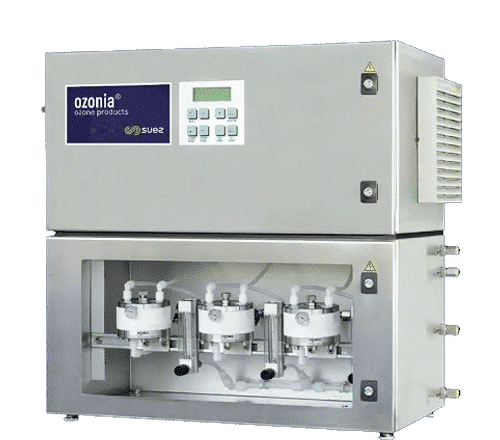
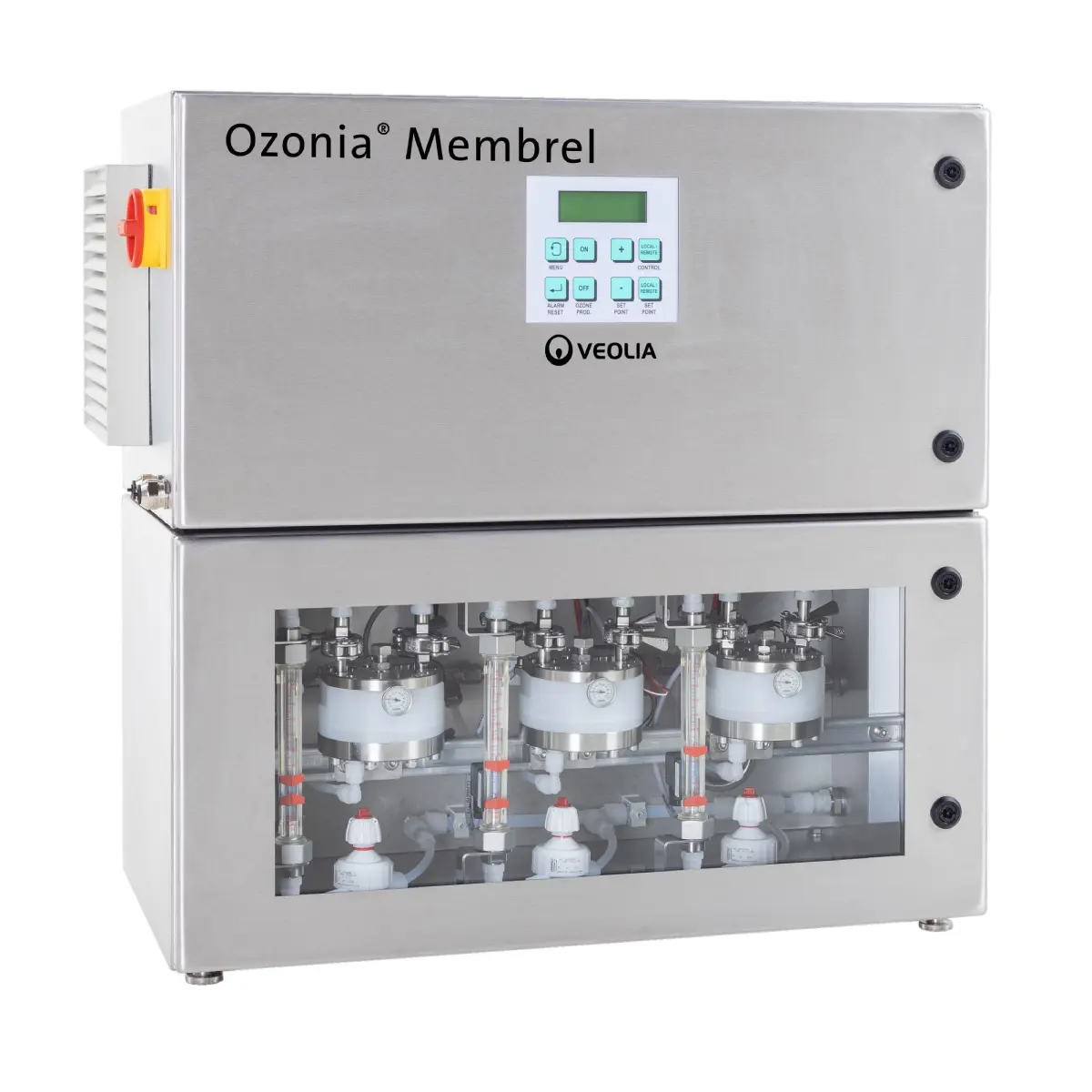
Ozonia Membrel is an electrolytic ozone technology developed specifically for pure and ultrapure water applications, including pharmaceutical water systems.
Unlike conventional corona-discharge ozone systems, the electrolytic process generates ozone directly from high-purity water rather than requiring an external air or oxygen feed to produce an ozone gas stream.
A side stream from the water loop passes through the electrolytic cell, where ozone is produced and returned into the circulating high-purity water. This architecture is particularly attractive where maintaining the integrity of a high-purity loop is important.
Where the system architecture uses continuous or background ozonation, UV deozonation can be used to destroy residual ozone before water reaches production points of use.
During the defined sanitisation cycle, the system is configured so dissolved ozone can circulate throughout the required storage and distribution surfaces before the loop is subsequently deozonated.
A pharmaceutical ozone system is not simply an ozone generator connected to a PW return line.
The complete operating sequence needs to define when ozone can operate, how the sanitisation condition is confirmed, what happens when a sensor or flow condition is invalid, how deozonation is controlled and when the system can return to production.
Sanitisation setpoints, sampling, acceptance criteria, instrument calibration, operating procedures and release back to production should be defined within the pharmaceutical manufacturer's own qualification, validation and quality framework.
The loop should maintain appropriate circulation and minimise dead legs, stagnant branches and areas that cannot be reliably exposed during sanitisation.
Flow, pressure, tank volume, pipe volume and return conditions determine how quickly the system can establish and distribute the required ozone residual.
A dissolved ozone reading at the tank alone does not necessarily demonstrate that the complete distribution loop has reached the intended sanitisation condition.
Even high-purity systems can exhibit ozone demand from surfaces, contaminants or operating conditions. The measured response matters more than generator output alone.
Pipework, seals, valve components, membranes and instrumentation should be reviewed for the intended ozone concentration, temperature and exposure duration.
The ozone-removal system must be appropriate for the water flow, residual ozone concentration and time available to return the loop to production.
Sanitisation should be based on measurable process conditions rather than assuming that generator runtime alone demonstrates treatment of the full system.
The correct sanitisation strategy depends on the existing PW system, manufacturing requirements and site validation philosophy.
A preliminary assessment normally starts with the hydraulic system, the existing water-treatment architecture and the site's intended sanitisation philosophy.
Understanding why biofilm develops and how flushing, sanitisation and ozone can form part of a control strategy.
Read the guide →Why ORP and direct dissolved ozone measurement provide different information in an ozone-treated water system.
Read the guide →Review common metals, plastics and elastomers used around ozone systems and high-purity water applications.
View compatibility guide →Ozone technology designed specifically for selected pure, ultrapure and high-purity water applications.
Explore systems →Send us the loop flow, tank volume, system layout, existing sanitisation method and operating requirements. We can review the ozone generation, circulation, monitoring and deozonation requirements as a complete system.