
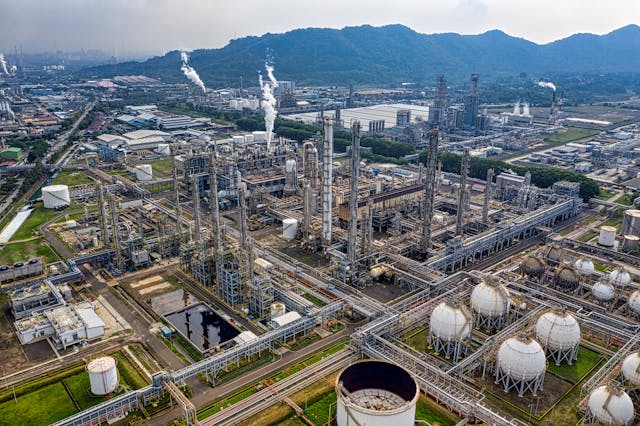
Petrochemical wastewater is rarely a straightforward oxidation problem. In most cases, the challenge is not simply high pollutant load, but a complex mixture of variable COD, refractory organics, phenolic compounds, sulphides, colour, toxicity, emulsified contaminants, and inconsistent biodegradability. That is one reason conventional treatment alone does not always deliver the required result, especially where the objective is tighter discharge quality, downstream polishing, or partial water reuse.
In this context, ozone can be a useful treatment tool, but not as a universal answer. Its real value in petrochemical wastewater treatment is usually as a selective oxidation and polishing step, or as part of an advanced oxidation approach where the aim is to break down refractory organics, reduce toxicity, improve biodegradability, or support the wider treatment train.
Why petrochemical wastewater is difficult to treat
Petrochemical effluent composition can vary significantly depending on process type, feedstock, plant operation, and upstream separation performance. Wastewater may contain phenols, aromatic compounds, aldehydes, sulphides, surfactants, oils, suspended matter, and other dissolved organics that are either poorly biodegradable or inhibitory to biological systems.
This matters because the remaining treatment problem is often not the easy fraction. In many plants, primary and biological treatment already remove the bulk load reasonably well. The difficulty lies in the persistent residual fraction, especially where the water still carries refractory COD, colour, toxicity, or compounds that interfere with discharge compliance or reuse objectives.
That is where ozone begins to become relevant.
Where ozone can add value
The strongest case for ozone in petrochemical wastewater treatment is usually not maximum COD destruction at any cost. More often, ozone is valuable in one or more of the following roles.
Oxidation of reactive contaminants
Ozone can react effectively with certain organic and inorganic species, including phenolic compounds, reduced sulphur species, odorous contaminants, and some colour-forming molecules. In practical terms, this can help reduce specific problematic fractions even where full mineralisation is not the aim.
Improvement of biodegradability
One of the most useful functions of ozone is partial oxidation. Instead of trying to completely oxidise every residual organic compound, ozone can break larger or more refractory molecules into smaller and more biodegradable intermediates. In the right application, this can improve downstream biological treatment and create a more efficient overall treatment strategy.
Polishing of secondary effluent
Many petrochemical sites already operate a treatment plant that handles the easier portion of the load. The remaining effluent may be lower in concentration, but harder to treat. In that situation, ozone can be considered as an intermediate or tertiary polishing step to address residual colour, refractory COD, specific organics, or toxicity.
Support for tighter discharge or reuse targets
Where discharge limits are becoming more demanding, or where partial reuse is under consideration, ozone can sometimes provide an additional oxidation barrier for persistent dissolved contaminants. Whether this is technically and commercially sensible depends heavily on the wastewater matrix and the treatment objective, but it can be a valuable part of a properly designed advanced treatment train.
In petrochemical wastewater, ozone is often most effective not as a first treatment step, but as a targeted oxidation stage applied after the bulk load has already been removed.
Ozone alone versus ozone-based AOPs
This is one of the most important distinctions in engineering terms.
Ozone on its own is a strong oxidant, but it is still relatively selective. That can be useful when the target compounds are readily ozone-reactive. However, if the wastewater contains a broader range of harder-to-oxidise organics, or if the target is deeper oxidation of refractory residuals, standalone ozonation may be too limited.
That is where ozone-based advanced oxidation processes become more relevant. These systems aim to increase hydroxyl radical formation and create a less selective, more aggressive oxidation environment. Depending on the application, this may involve combinations such as ozone with hydrogen peroxide, ozone with UV, or catalytic ozonation.
For petrochemical wastewater, the practical question is not whether ozone is strong. It is whether direct ozonation is enough for the compounds that remain after upstream treatment. In some cases it is. In others, an AOP approach is much more realistic.
Important design considerations
This is where the subject becomes more engineering-driven and less theoretical. In petrochemical wastewater, performance depends far more on system integration than on generator capacity alone.
Wastewater characterisation comes first
Before an ozone system can be evaluated properly, the wastewater needs to be understood in practical terms. That usually includes COD and ideally TOC, phenols and other target organics, sulphides and reduced inorganic species, oil and grease, suspended solids, pH and alkalinity, conductivity or salinity, biodegradability indicators such as BOD/COD ratio, and variation by batch, shift, or process area.
This matters because ozone demand is rarely defined only by the contaminant you want to remove. Competing demand from other oxidisable species can consume ozone very quickly and materially change process performance.
Mass transfer matters
Ozone is generated as a gas and must be transferred into the liquid phase effectively. In industrial wastewater treatment, this is often one of the real limiting factors. Poor contacting means poor utilisation, higher operating cost, and misleading expectations.
Gas concentration, injection method, contactor design, pressure conditions, off-gas handling, and hydraulic retention all affect how much ozone actually dissolves and reacts. For that reason, ozone application in petrochemical wastewater cannot be reduced to chemical reaction alone. Mass transfer is a core part of the design.
pH changes the reaction pathway
Ozone chemistry is strongly affected by pH. At higher pH, ozone tends to decompose more rapidly and can promote greater radical formation. In some cases that improves oxidation performance. In others, it simply changes the chemistry without improving outcomes in a meaningful way.
The wider matrix also matters. Alkalinity and radical scavengers can significantly reduce oxidation efficiency, especially in advanced oxidation systems. So pH is not a simple optimisation knob. It needs to be considered in the context of the full water chemistry.
Upstream condition matters
If the wastewater still contains significant free oil, unstable emulsions, or high suspended solids, ozone is often being introduced too early. In most cases, ozone becomes more valuable after bulk separation and easier treatment steps have already done their job.
That is why it is so often positioned as an intermediate or polishing stage rather than the first treatment step.
Where ozone is often not the best first answer
It is easy to assume that a difficult petrochemical effluent automatically calls for stronger oxidation. In reality, that is not always the best approach.
Very high-strength streams with extreme alkalinity, high sulphide loading, or heavy contamination may not be suitable for straightforward ozonation as a primary answer. In those cases, broader treatment strategy matters more than oxidant strength alone. The best solution may involve staged treatment, improved equalisation, upstream separation, biological conditioning, or a hybrid AOP approach rather than simple ozone dosing.
Likewise, where the wastewater varies heavily over time, ozone can appear inconsistent if the feed is not first stabilised. That is not necessarily a weakness of ozone itself. It is often a sign that the treatment train has not yet been structured correctly.
A practical way to think about ozone in petrochemical wastewater treatment
For most real applications, the better question is not:
Can ozone treat petrochemical wastewater?
It is:
Where in the treatment train does ozone create the most value?
In some systems, that means pre-oxidation to reduce toxicity or improve biodegradability. In others, it means polishing after biological treatment to address residual refractory COD, colour, or specific dissolved contaminants. And in more demanding cases, it may only become technically sensible when used as part of an ozone-based AOP rather than simple direct ozonation.
That distinction matters because ozone should not be judged only by oxidising power. It should be judged by how effectively it helps the full process reach its objective.
Final thought
Ozone can be a valuable tool in petrochemical wastewater treatment, but it works best when applied with clear intent. It is not simply a powerful oxidant that can be dropped into any difficult industrial effluent. Its success depends on wastewater characterisation, reaction selectivity, mass transfer, competing ozone demand, pH, and where the oxidation stage sits within the wider treatment scheme.
In practice, the most successful ozone applications in petrochemical wastewater are usually the ones designed around the treatment train, not around generator size alone.
Evaluating ozone for a petrochemical wastewater stream?
The right solution usually depends on wastewater characterisation, treatment objectives, and where ozonation fits within the wider treatment process.