Home › Insights › Understanding Ozone CT: Why Contact Time Matters as Much as Ozone Dose

Understanding Ozone CT: Why Contact Time Matters as Much as Ozone Dose

Understanding Ozone CT: Why Contact Time Matters as Much as Ozone Dose

When people talk about ozone systems, the focus usually goes straight to generator output. How many grams per hour? How much dissolved ozone? How much gas flow?

Those figures matter, but they do not tell the full story.

To understand whether an ozone process is likely to work properly, you need to look at CT. This is one of the most important concepts in ozone treatment, yet it is often overlooked.

What is ozone CT?

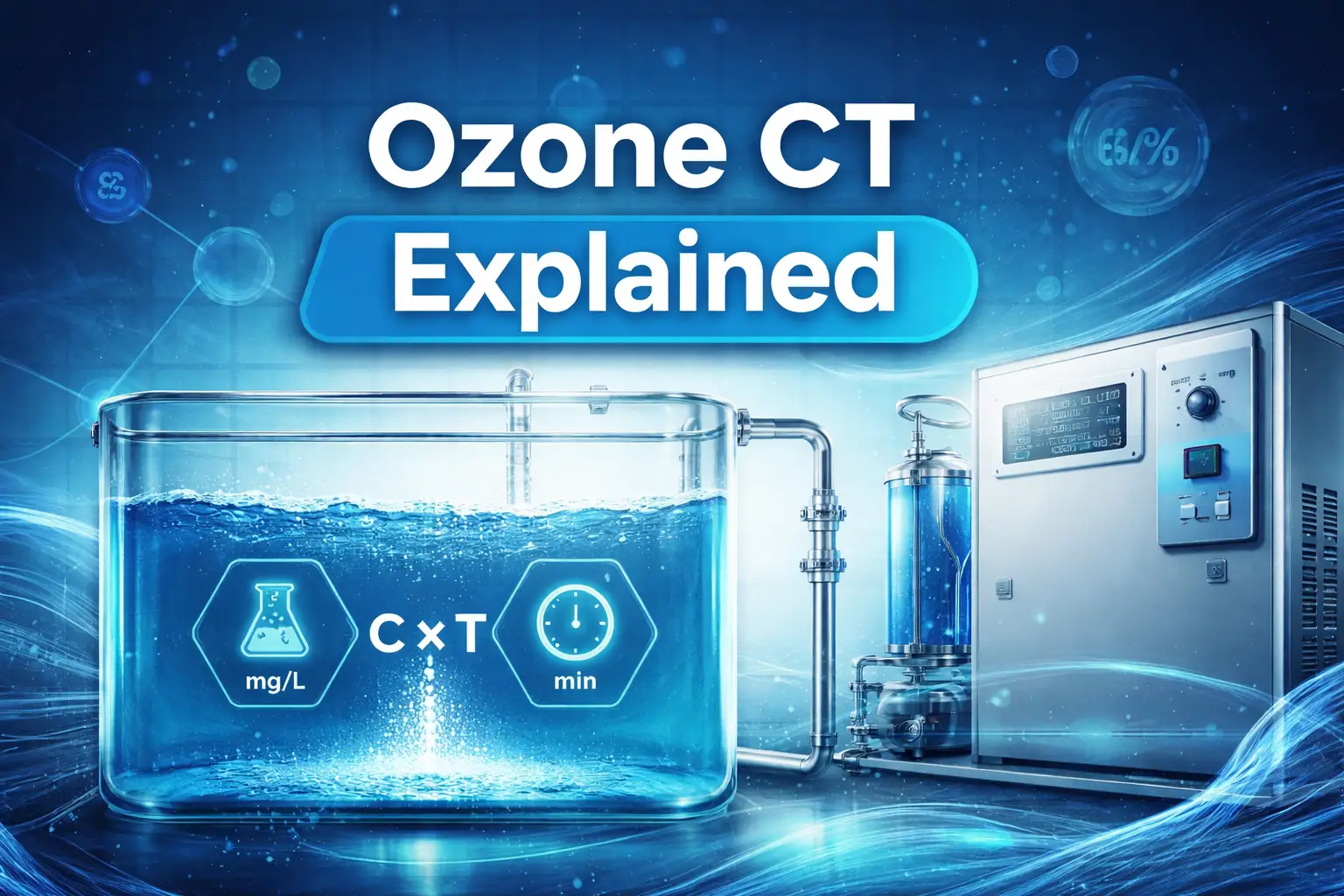
CT stands for Concentration × Time.

In simple terms:

  • C = ozone concentration in water, usually in mg/L

  • T = contact time, usually in minutes

So if you have 0.5 mg/L dissolved ozone for 4 minutes, the CT is:

0.5 × 4 = 2.0 mg·min/L

This gives a more useful picture of treatment performance than concentration alone.

Why CT matters

Ozone is a very strong oxidant, but it reacts quickly. As soon as it dissolves in water, it starts reacting with whatever is present, including:

  • microorganisms

  • organic matter

  • iron and manganese

  • sulphides

  • colour compounds

  • other oxidisable contaminants

That means ozone concentration on its own is not enough. What matters is how much ozone remains available, and for how long.

A strong dose with almost no contact time may do less than a lower dose held for longer.

Ozone dose alone does not tell the whole story

It is easy to assume that a higher dissolved ozone reading means better performance. In practice, that is not always true.

Example

System A

  • Dissolved ozone: 1.0 mg/L

  • Contact time: 30 seconds

  • CT = 0.5 mg·min/L

System B

  • Dissolved ozone: 0.4 mg/L

  • Contact time: 5 minutes

  • CT = 2.0 mg·min/L

Even though System B has a lower ozone concentration, it provides a much greater overall ozone exposure.

That is why CT is so important. It shifts the conversation from machine output to actual treatment effect.

Where CT becomes important in real applications

CT matters in almost every ozone water treatment process, but it is especially important in the following areas.

Disinfection

For ozone disinfection, the goal is not simply to inject ozone into water. The target organisms must be exposed to enough ozone, for long enough, to achieve meaningful inactivation.

Oxidation before filtration

In many systems, ozone is used ahead of media filters, carbon filters, or UV. In these cases, ozone may be partially oxidising contaminants rather than fully destroying them. Without enough CT, that upstream oxidation may be incomplete.

Food wash water

In produce washing and food processing, short residence times and high organic load can consume ozone quickly. CT helps determine whether the system is likely to deliver real microbial or oxidation benefit.

Recirculating water systems

In recirculated systems such as process water loops, cooling water, aquaculture, or storage tanks, each pass still has its own effective CT. Understanding that helps avoid both underdosing and overdesign.

What affects ozone CT in practice?

CT may look simple on paper, but real systems are affected by several practical factors.

Ozone transfer efficiency

If gas transfer into water is poor, the starting concentration will be lower than expected. A large generator cannot compensate for bad transfer efficiency on its own.

Water quality

Water with high organic content, metals, or other reducing compounds can destroy ozone quickly. That reduces residual ozone and lowers the real CT.

Contact tank design

Nominal retention time is not always the same as effective contact time. Poor hydraulics, short-circuiting, and dead zones can all reduce treatment performance.

Temperature and pH

Higher temperatures generally reduce ozone stability. In many cases, higher pH can also accelerate ozone decomposition. Both can affect the actual residual available over time.

CT is not just about tank size

A bigger contact tank does not automatically mean better ozone treatment.

If ozone transfer is poor, or if demand is too high, a larger tank alone may not solve the problem. Good CT depends on the whole process working together:

  • ozone generator

  • gas-to-liquid transfer

  • hydraulic contact

  • off-gas control

  • water quality

  • residual monitoring

This is why ozone systems should be designed around treatment objectives, not just equipment size.

The difference between theoretical CT and real CT

This is where many systems look better on paper than they do in operation.

A design may assume a certain ozone residual and a certain retention time. But the real CT may be lower because of:

  • fluctuating flow

  • variable water quality

  • residual ozone decay

  • poor mixing

  • inaccurate assumptions about contact conditions

Theoretical CT is useful for design. Real CT is what determines performance.

Why CT is often overlooked

CT is less visible than hardware. People can easily compare generator sizes, oxygen concentrators, injectors, or tank volumes.

But CT is the part that links all of these together.

If a system is specified only by ozone production rate, without properly considering residual concentration and contact time, there is a risk that the design is focusing on equipment rather than results.

Final thoughts

Ozone CT is one of the most useful ways to judge whether an ozone process is likely to work.

It reminds us that ozone performance is not just about how much ozone is produced. It is about how much is dissolved, how long it remains available, and how effectively it can react in the process.

In simple terms, ozone dose without contact time is incomplete, and contact time without residual ozone is meaningless.

That is why CT should always be part of serious ozone system design.